How to use By quantity for wholesale and volume offers
Quantity tiers and 2×1 to drive bigger orders without touching list prices.
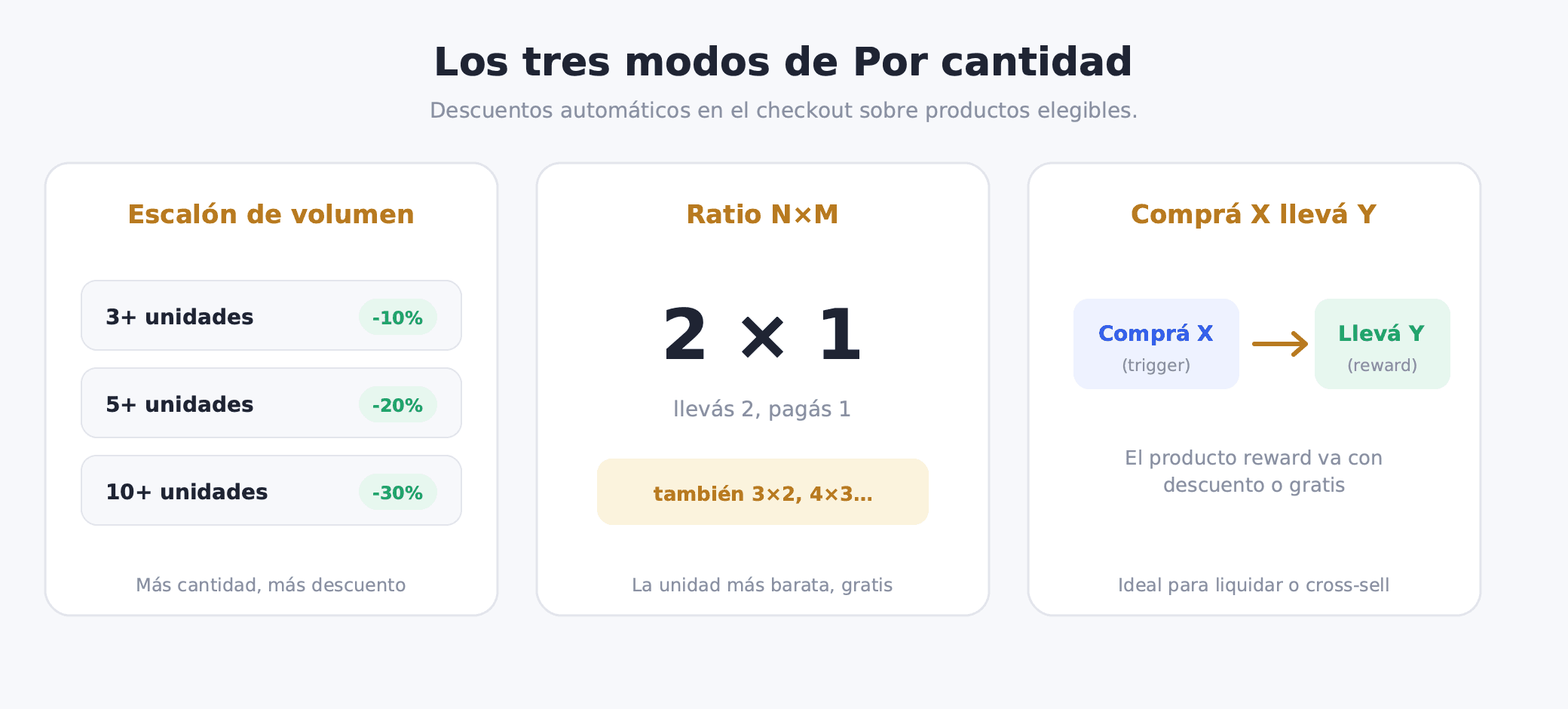
Most TiendaNube stores do not have a separate B2B store. Offering volume pricing means falling back on manual discount codes — which do not scale — maintaining a duplicate product catalog for wholesalers — expensive and difficult to keep in sync — or simply offering nothing and letting the wholesale buyer pay retail prices or walk away.
Combos By quantity solves this in a far more direct way: you configure the discount rules once, and they apply automatically every time a cart qualifies. No manual intervention, no parallel catalog, no special account required for the customer.
The wholesale problem for small and mid-size stores
A store that sells to boutiques, resellers, or regular buyers who order in quantity needs some way to differentiate pricing by volume. Traditional approaches have serious friction:
- Volume discount codes: you have to create them, distribute them, track which customer has which code, and there is nothing stopping someone from sharing them. They do not scale.
- Separate wholesale catalog: you have to maintain two sets of products, two price points, two operations. Every change to the main catalog has to be replicated.
- Single list price for everyone: the wholesale buyer pays the same as the retail buyer, which actively discourages bulk purchases.
Combos By quantity resolves this without touching public list prices. The price any visitor sees on the store stays the same. The discount only appears at checkout when the cart qualifies by quantity.
How volume tiers work for wholesale
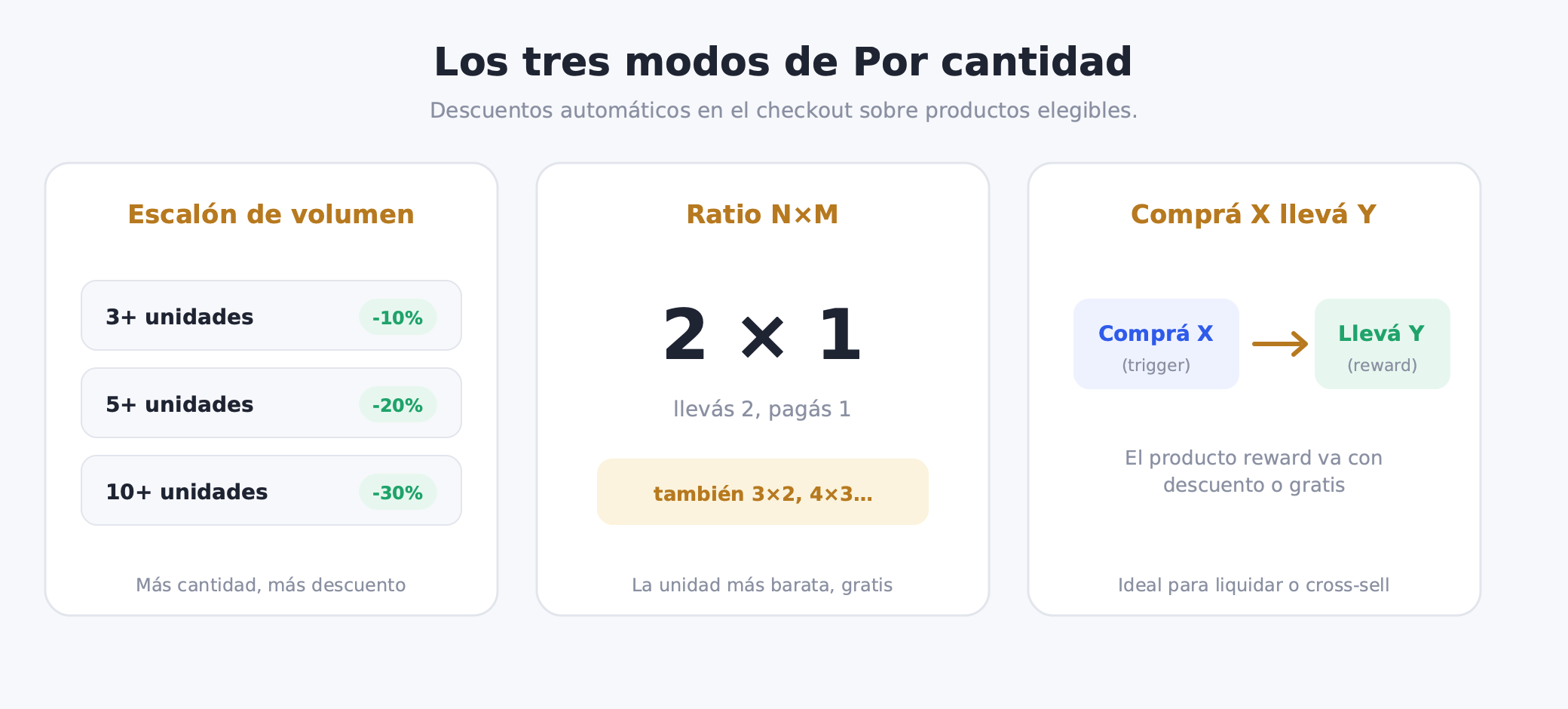
Consider an apparel store selling jackets. A reseller or small boutique typically buys between 5 and 20 units per order. You can configure tiers that reward exactly that:
| Minimum units | Discount |
|---|---|
| 3 | 10% |
| 5 | 20% |
| 10 | 30% |
The buyer adds 10 jackets to the cart. At checkout, they automatically see 30% off applied. No code needed. No special account. They just had to add the units they already wanted to buy.
This also works in reverse: the retail buyer who comes in with 1 or 2 units pays full list price. The volume tiers are invisible to them because their cart never triggers them.
Use case 1: wholesale for fashion and apparel
An apparel brand selling to boutiques or corporate gift buyers can configure a volume-tier By quantity bundle over their basics collection.
Example: a t-shirt brand with tiers at 3 units (10%), 6 units (18%), and 12 units (25%). The list price of the t-shirts is the same for everyone. The buyer who loads 12 t-shirts into the cart automatically sees at checkout that they are paying 25% less. No negotiation, no phone call, no discount code. The system handled everything.
This approach works especially well for high-turnover seasonal products with few price variants: cotton basics, uniforms, merchandise items, fashion accessories. The wholesale buyer can browse the normal catalog, add what they want, and see the discount when they hit the quantity that justifies the special price.
It is also useful for corporate buyers or gifters placing bulk orders: the volume incentive pushes them to consolidate everything into one order instead of placing several small orders.
Use case 2: 2×1 and N×M for cosmetics and supplements
The N×M ratio is the most well-known Combos By quantity format. "Buy 2, get 1 free" is one of the most effective promotional mechanics for consumables because the customer already knows they will need the product again.
How it works in Bundle: you configure the ratio (N=2, M=1 for 2×1; N=3, M=2 for 3×2). The cheapest eligible item in the cart receives the discount. The customer does not have to do anything special — the system identifies the cheapest item and discounts it automatically.
Concrete examples:
- Cosmetics: a store runs a 2×1 on face serums for summer clearance. The customer adds 2 serums; the cheaper one goes free. If both cost the same, either one receives the discount.
- Supplements: 3×2 on protein powder. The buyer who wants to stock up purchases 3 tubs; they pay for 2. The third tub — the cheapest — goes free.
- Personal care: 2×1 on sunscreen at the end of the season. Helps clear stock before seasonal demand shifts.
N×M works particularly well for consumable repeat-purchase products where the customer already has repurchase intent. Combos By quantity incentivizes them to consolidate that future repurchase into the current order.
Use case 3: buy X get Y for cross-sell
Buy X get Y allows a different mechanic: a trigger product unlocks a reward product at a discount or free of charge.
Practical applications for wholesale and volume selling:
- Introducing new SKUs: the customer already buys product A in volume. If you add a new product B as a trigger or reward, they try it at no extra cost. This accelerates rotation of the new SKU.
- Clearing complementary inventory: buy 5 jackets (trigger) and get 5 belts (reward) at 40% off. The customer who is already coming for the jackets now has an incentive to add belts to the order.
- Free shipping as a reward: use a landing product to communicate that orders above a certain number of units qualify for free shipping. This removes the friction of calculating shipping costs on volume orders.
Margin math for wholesale tiers
Before configuring tiers, do the margin math. Combos By quantity does not know your cost structure — that is your responsibility.
A simplified example: if a product has 50% gross margin and you offer 20% off to customers buying 5 or more units, you keep 30% gross margin on those units. That can be perfectly acceptable if the volume of those sales offsets the difference.
What changes with volume is the fulfillment cost per unit. In an order of 10 units to the same destination, the per-unit cost of picking, packing, and shipping is usually lower than in 10 separate single-unit orders. That logistical efficiency is part of the margin you can pass on to the customer as a discount.
A practical rule: start with tiers that activate at quantities two to three times higher than your current average order. If your average order is 2 units, the first tier could sit at 4 or 5. That way the discount rewards genuine volume buyers without wasting margin on orders you were already getting at the standard price.
Combining Combos By quantity with other promotions
If you have multiple By quantity offers active at the same time on products that overlap, the priority setting determines which one applies. The lower priority number wins.
A typical scenario: you have a volume-tier By quantity offer covering your entire basics collection, and a specific 2×1 By quantity offer on one t-shirt you want to clear. If a cart qualifies for both, priority decides which discount is applied. You set the priority based on which discount you want to take precedence.
To avoid confusion, it helps to be clear about the eligible products for each By quantity offer before configuring priorities. If the eligible products do not overlap, there is no conflict and priority does not matter.
What Combos By quantity does not replace
Combos By quantity is an automatic discount mechanism at checkout. It is not a complete B2B solution. What it cannot do:
- Show different prices to different types of customers before checkout
- Create wholesale accounts with different payment terms (net 30, purchase orders, etc.)
- Generate per-customer custom catalogs
- Handle credit, B2B invoicing, or contractual terms
For a business that has enough B2B volume to justify a separate wholesale operation, Combos By quantity is a workaround, not a solution. But for most stores that want to offer simple volume incentives — without the complexity of a dual operation — it is more than sufficient.
How to set it up in Bundle
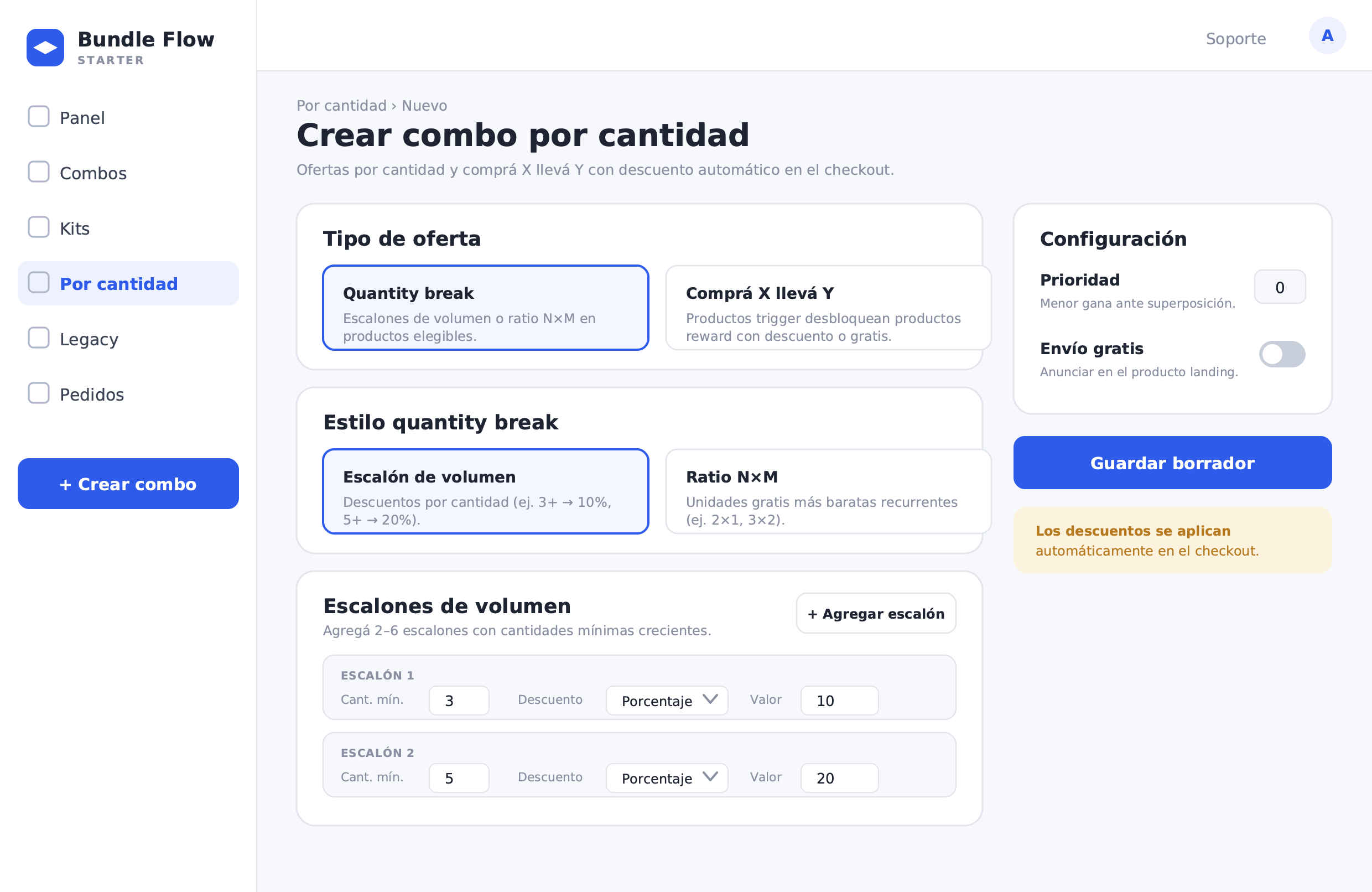
The flow for a volume By quantity offer is straightforward. The initial status is draft.
- By quantity → Create bundle (BETA). Status starts as draft.
- Name: use a descriptive name for internal use. For example: "Fall jacket wholesale" or "2×1 serums summer."
- Offer type: select Quantity break.
- Style: Volume tier (for quantity-based tiers) or N×M ratio (for 2×1, 3×2, etc.)
- Eligible products: add the products that count toward the threshold. You can lock specific variants if you only want to apply the discount to certain sizes or colors.
- Tiers (if you chose Volume tier): add 2 to 6 rows. Example: min 3 → 10%, min 5 → 20%, min 10 → 30%. Minimum quantities must be increasing.
- For N×M: configure N and M. The system automatically applies the discount to the cheapest eligible item.
- Priority: assign a number. If you have other active By quantity offers on products that overlap, the lower number wins.
- Save as draft and publish. Discounts apply automatically at checkout from that point on.
What to measure after activating Combos By quantity
The metrics that matter most for evaluating a volume By quantity offer:
- Average units per order: compare before and after activation. If it increased, Combos By quantity is working.
- Revenue per customer session: is the same traffic generating more revenue?
- Percentage of orders reaching each tier: if most orders stay at the first tier, the second may be set too high, or the communication of the tiers is not clear enough.
- Margin per tier: calculate net margin on orders at each tier. Volume has to compensate for the margin compression.
- Returning buyer behavior: are customers who were already placing volume orders now ordering even more? Are there new buyers appearing for the first time with large carts?
Combos By quantity does not require the customer to do anything differently from what they were already doing. They just add more to the cart and the discount appears. That absence of friction is the central point of the tool: you reward volume without creating a parallel buying experience.