How fitness and supplement stores use Combos
A merchandising guide for building flexible training packs without breaking operations or fulfillment.
Why bundles work in fitness
The fitness shopper is one of the most predictable buyers in e-commerce. They arrive with a clear goal — build muscle, lose weight, improve endurance — and they already have a rough sense of what they need. They are not browsing. They are looking for the right combination of products to support their routine.
That clarity of intent makes supplements a natural fit for bundles. Nobody just buys protein. Most people add creatine, BCAAs, pre-workout, or an accessory. The stack already exists in the customer's mind; the store just needs to surface it as a concrete offer.
Repurchase rates in supplements are high. A customer who buys today will be back next month to refill. If the first purchase includes an accessory or a complementary supplement, the second order might too. Average order value climbs when you pair the core product with extras the customer would have bought separately anyway.
There is also a product education angle. A well-structured pack signals expertise. "Protein plus creatine plus shaker" is not just a cross-sell — it is a stack recommendation from someone who understands the sport. That builds trust with first-time buyers who are still figuring out what to take.
What are Combos
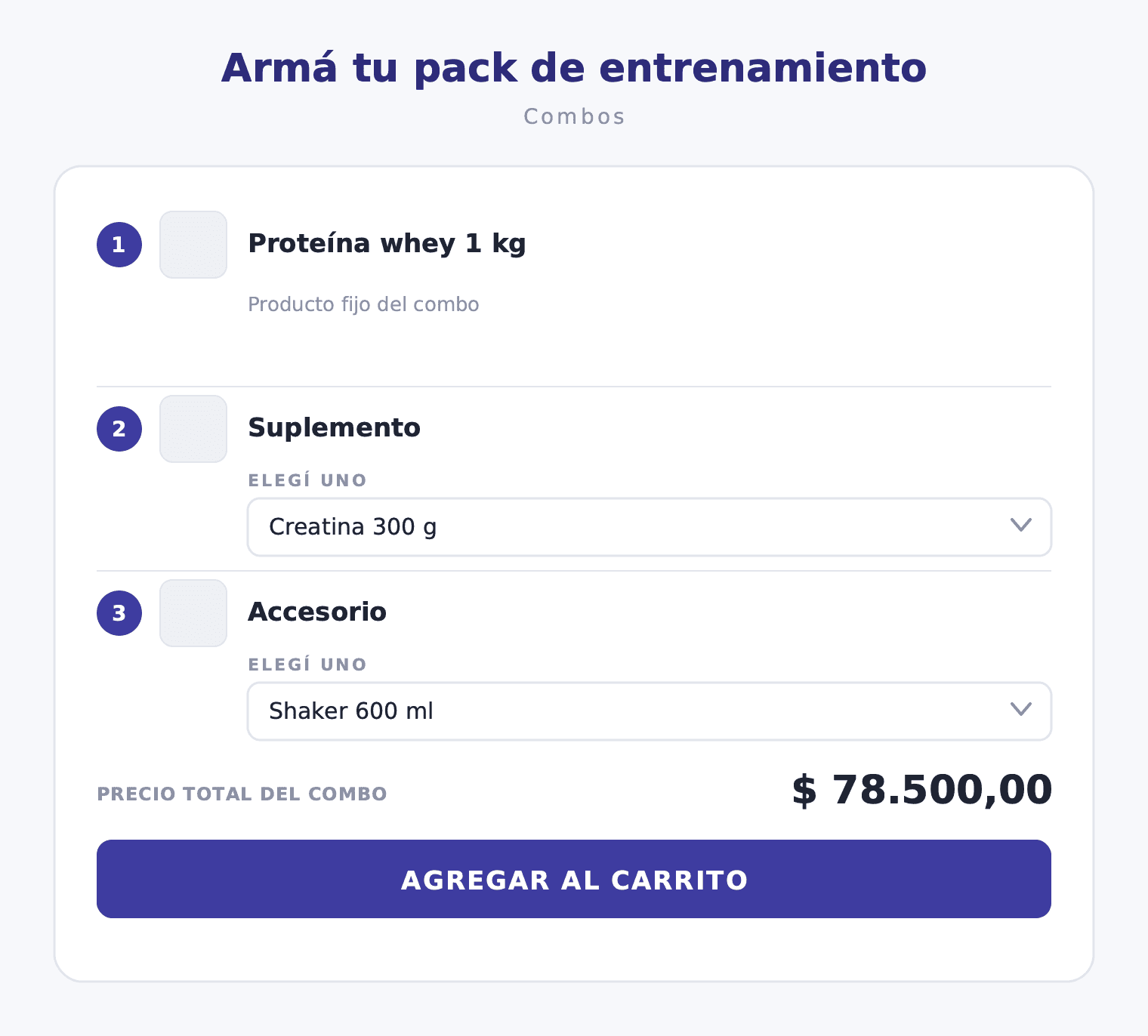
Combos is a structure you define in the store's admin panel that the shopper completes from the storefront. You set how many slots the pack has, which product goes in each slot, and whether each slot is fixed (always the same product) or choosable (the shopper picks from a list of options). The shopper works through each slot, makes their selections, and adds everything to the cart in one click. The order shows individual SKUs plus an automatic discount line. It is not a fixed kit. It is not an artificial bundle product. It is a guided purchase flow with a built-in discount.
How it works
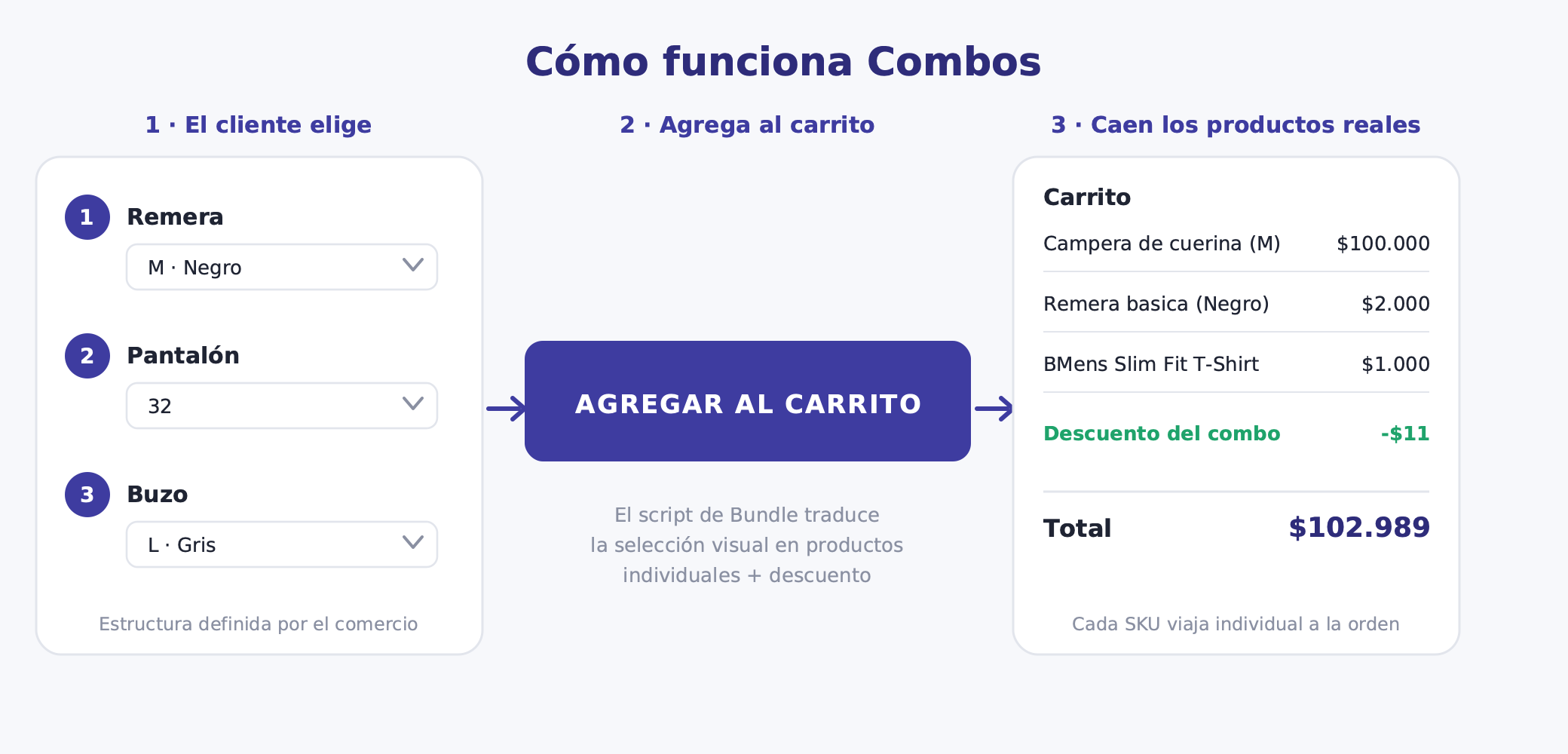
Each slot in the widget corresponds to a component you configured in the admin panel. A slot can be fixed, meaning the shopper sees the product but cannot change it — for example, a 1 kg whey protein, no dropdown. Or it can be choosable, meaning the shopper picks from the variants you enabled — for example, creatine, BCAAs, or glutamine.
When the shopper fills all slots, one button adds everything to the cart. The products land as individual SKUs with the discount applied automatically. No artificially created bundle product is involved.
| Slot | Type | Shopper choice |
|---|---|---|
| Whey protein 1 kg | Fixed | Base product of the pack |
| Supplement | Choosable | Creatine / BCAAs / Glutamine |
| Accessory | Choosable | Shaker / Gloves / Resistance band |
The table shows the typical structure of a fitness pack with three slots: the first fixed (always the same whey), the second and third choosable. The shopper picks the supplement that best fits their routine and the accessory they need or want to replace.
Bundle ideas for fitness stores
Starter pack. Whey protein plus a shaker plus a pre-workout sample. Ideal for the new customer who is not yet sure what they want. The shaker is nearly a necessity, and the pre-workout sample generates curiosity without adding significant cost. The ticket is not high but the purchase experience feels complete and intentional.
Strength stack. Protein plus creatine plus an optional accessory — gloves, lifting belt, or straps. This targets the intermediate customer who already has a base and wants to optimize muscle gain. Creatine is the most obvious complement to protein for this goal, and the accessory increases the ticket without making the offer feel forced.
Recovery pack. Protein plus BCAAs plus a recovery supplement — magnesium, collagen, or similar. For the higher-volume trainer who understands that recovery is part of progress. This pack works well for more demanding sports categories: crossfit, long-distance running, cycling.
Travel pack. Single-serving protein sachets plus snack bars plus a shaker. Aimed at the customer who travels frequently and does not want to break their routine. Travel-size formats often have good margins but slow movement on their own; inside a travel bundle they find the right context and the right buyer.
Monthly refill. Protein plus pre-workout, same flavor as last month. Built for the customer who has already settled on their combination and wants to refill without thinking. The structure is simple: two choosable slots with flavor options. This works especially well when paired with email or messaging reminders as the customer approaches the end of the month.
Which variants matter in fitness
Flavor is the most critical variant in supplements. Chocolate, vanilla, and strawberry are the top three; shoppers will want to choose the flavor of their protein and their pre-workout independently. Do not assume that a customer who wants chocolate protein also wants chocolate pre-workout. Leave that decision to the shopper.
Size matters for protein (500 g vs. 1 kg) and for some supplements that come in different presentation sizes. In a fixed slot you may not need to expose size if the pack is defined with a specific size. In a choosable slot it makes sense to show it if there is a meaningful price difference between formats and the customer needs to make a conscious choice.
Experience level — beginner versus advanced — is not a product variant but it organizes bundles well. A starter pack with smaller doses and milder products makes sense as a distinct offering from an advanced stack with higher doses. Build separate packs instead of trying to fit everything into one. Segmenting by training goal makes each pack more relevant and easier to communicate in campaigns.
The general rule: only expose the variants that make sense for the goal of each slot. If the shaker comes in one color, do not show a dropdown. If creatine comes in one flavor, show nothing. Fewer decisions mean less friction, which means higher bundle conversion.
Choose a discount that protects your margin
Margins on supplements vary considerably by brand and channel. A small percentage on the total pack — 5 to 10 percent — usually performs better than a deep discount on the hero product.
You can also use a low-cost item as a gift within the pack: a shaker at zero cost when the shopper completes the full stack. The real cost to the store is low; the perceived value for the shopper is high because the shaker is something they need anyway.
Another option is a fixed amount off: a flat discount that applies when all slots are filled. This works well when products in the pack vary in price by flavor or size and you want a consistent incentive that does not change with the shopper's selection.
What to avoid: discounts so aggressive on the hero product — the 1 kg whey, for example — that they train customers to always wait for a bundle before buying. The bundle should increase ticket size, not condition shoppers to buy for less. If a product already converts well on its own, use the bundle to move the complementary items, not to discount the one that already sells.
Stock risk in supplements
Popular flavors sell out first. Chocolate protein will always move faster than strawberry. If you only have chocolate available in a choosable slot, the widget will work but the shopper has no real choice. That frustrates the experience and may cause them to abandon the pack entirely.
The minimum rule: every choosable slot should have at least two or three valid options in stock before the pack goes live. Monitor stock pressure on high-velocity SKUs — chocolate, vanilla — and rotate the slot options if one runs out during the campaign.
An important note: if a choosable slot has zero valid options because all inventory is at zero, the shopper cannot complete the bundle. The widget does not allow adding to cart if any slot is incomplete. Before launching, verify that every slot has available stock. And before major campaigns, review projected stock for the campaign window.
Operations: why the real SKU matters
This is the differentiator that gets mentioned least but matters most as operations scale. Every product in the bundle lands in the order as its own SKU. There is no artificial bundle product and no invented reference that the warehouse needs to translate.
Your fulfillment partner, your own shipping team, or TiendaNube's Full service sees orders with real SKUs: "chocolate whey protein 1 kg, unflavored creatine 300 g, black shaker." They pick what they always pick. No mapping tables, no special instructions, no new fulfillment logic to learn.
The same applies to accounting tools like Contabilium and similar integrations: they see real order lines with real products. No reconciliation of a fictional product, no inventory discrepancies between what the store sold and what the system recorded.
This point is especially important at high volume or when using third-party fulfillment. A bundle that creates an artificial SKU generates inventory problems from day one. One that uses real SKUs changes nothing in your existing operation because the warehouse already knows how to handle those products.
How to set it up in Bundle
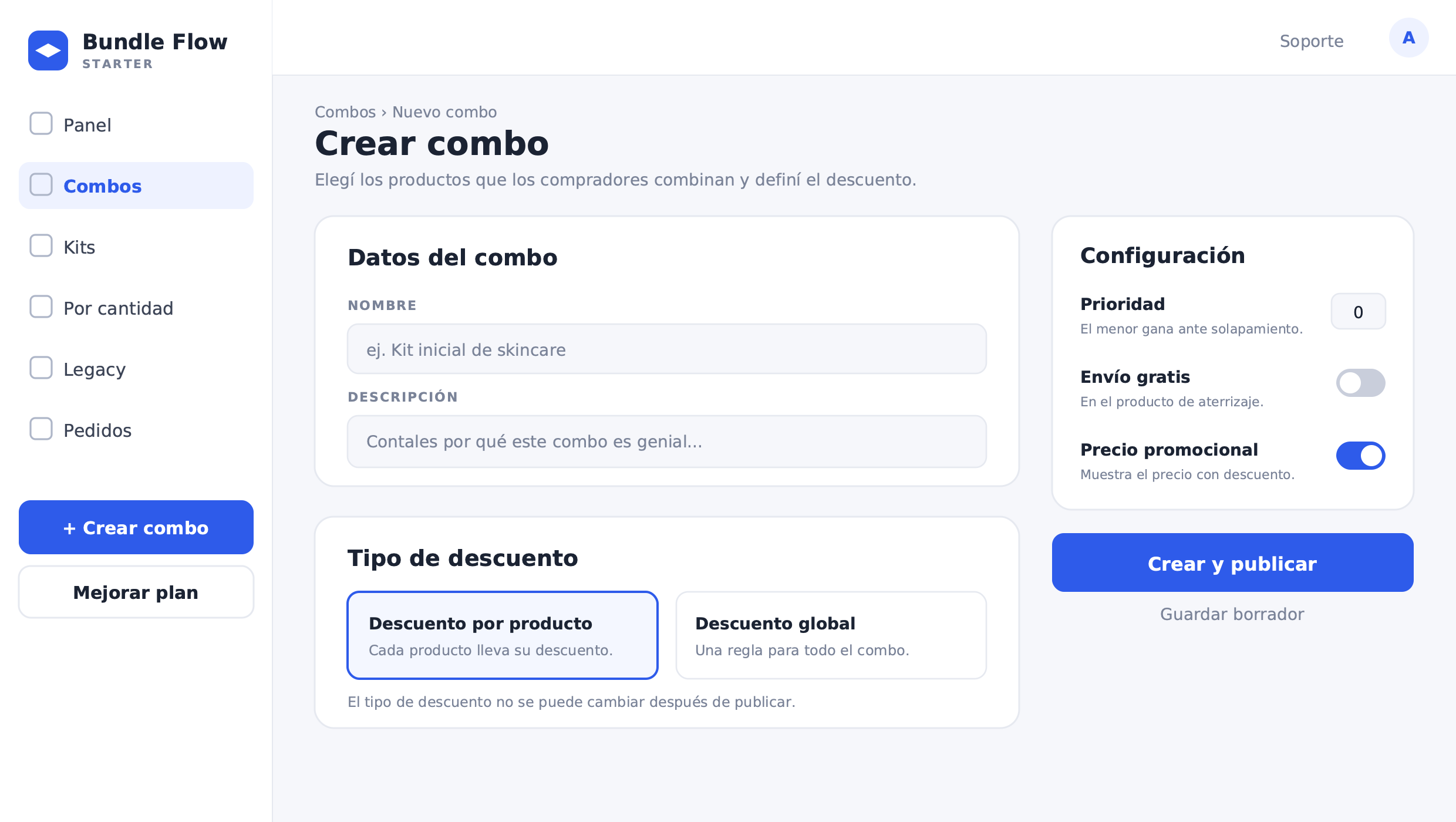
The configuration flow is straightforward. Here are the steps:
- Go to the Combos section and select "Create bundle" (BETA module).
- Enter the pack name — for example, "Fitness starter pack" — and the description shoppers will see in the widget.
- Choose the discount type: per-product (each slot has its own discount) or global (one rule for the whole pack). This setting cannot be changed after publishing, so choose carefully before going live.
- Add components with "Add product." For each one, configure:
- Quantity
- Variants: Locked (the whey is always the same, no dropdown) or Allowed variants (creatine, BCAAs, and glutamine as choosable chips; shaker, gloves, and band as accessory chips)
- Per-item discount if you chose per-product type
- In Settings, adjust the pack priority, whether it activates free shipping, and whether it has a promotional price.
- Under Landing product, choose the product page where the widget will appear — usually the main product in the pack — and review the slot preview before publishing.
- Publish with "Create and publish" or save as a draft. You can pause and resume the pack at any time. While paused, the widget is hidden in the storefront and discounts are not applied.
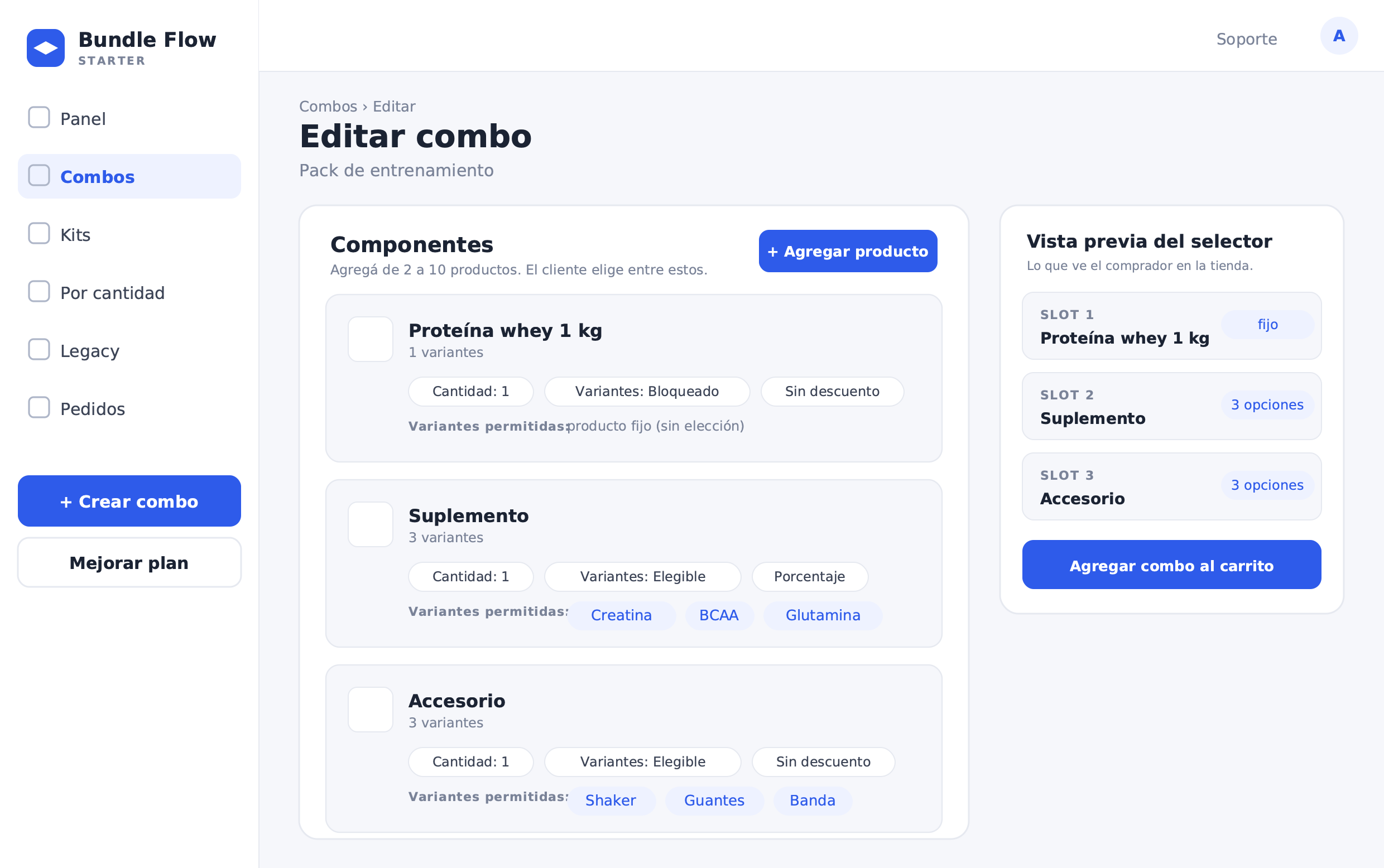
Each component you configure in the admin panel corresponds to one slot in the storefront widget. Locked variants produce a fixed slot: the shopper sees the product but makes no selection. Allowed variants produce a choosable slot: the shopper sees chips with the options you configured and picks one. You can mix fixed and choosable slots freely within the same pack.
What to measure
Once the pack is live, track these metrics to evaluate performance and decide where to adjust:
- Units per order: is the pack increasing the number of products per transaction compared to standalone protein purchases?
- Average order value: do orders that include the bundle show a higher AOV than those that do not?
- Bundle conversion rate: of shoppers who see the widget, how many complete the pack and add to cart? This is the central metric for evaluating whether the pack is well designed or generating friction.
- Variant popularity: which flavors and options do shoppers choose most in the choosable slots? This tells you what to keep in stock and which options to add or remove.
- Stock pressure: which SKUs run out of inventory fastest? Favorites in choosable slots will move faster than average because the bundle exposes them consistently.
- Repeat purchase rate: do customers who bought the starter pack come back for the monthly refill? This is the most important long-term indicator in fitness.
Closing thoughts
A good fitness bundle guides the buyer toward a complete stack without locking everyone into the same combination. The slot structure handles the complexity of the offer; the customer just picks their preferences. That is exactly what a well-designed pack should do: simplify the decision without taking control away from the shopper, and increase the ticket without making the offer feel forced.